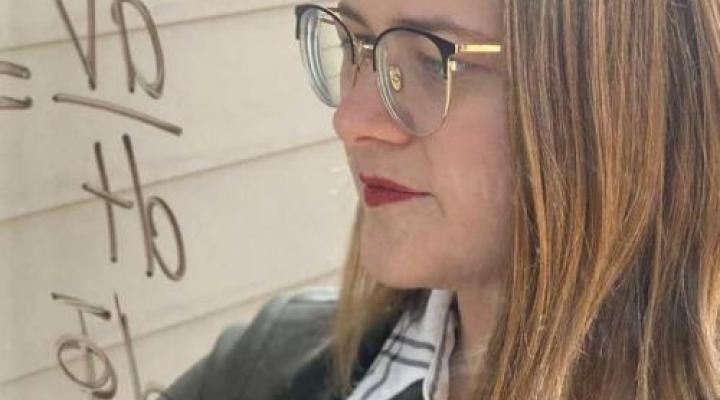
Just a picture of Rhodes Hall.


Welcome to CAM!

The Center for Applied Mathematics (CAM) administers the graduate Field of Applied Mathematics. Graduate education is a vital function at Cornell University. From the student's point of view, the Applied Mathematics graduate program offers not only the opportunity to work at a major university, but flexibility and accommodation to individual needs and interests. Applied Mathematics is one of the most diverse graduate fields; the range of possibilities of graduate research encompasses the areas of specialization of all the faculty members in the field, who currently number more than eighty. As a Cornell graduate student in applied mathematics, you will find a culture of respect and trust and a collegial atmosphere in which to study and that encourages you to excel. To apply to our program, see details here.


Some CAM student work interests:

Neural models and multiple time scales
My research involves developing and analyzing models of neurons from a multiple time scale point of view. The models are ordinary differential equations, to which we apply the tools of geometric singular perturbation theory. The application is to neurons involved with breathing. By splitting the system into fast and slow subsystems and looking at bifurcations in these subsystems, we can gain insight into mechanisms underlying changes in firing patterns. I also hope to develop parameter optimization algorithms which take advantage of the fast-slow structure.

  - Joe Tien

The Mathematics of Card Shuffling
I am interested in the question, How many times do you need to shuffle a deck of cards before it is close to random? Intuitively, if you shuffle enough times, the order of the cards shouldn't depend on the initial order of the deck. This intuition was in fact confirmed already in the early twentieth century by Markov and Poincare. But given 52 cards, exactly how many times do you need to shuffle the deck? 10? 100? 1000? This area of research builds on tools and ideas from a number of areas, including probability, algebra, functional analysis, combinatorics, and representation theory.

  - Sharad Goel

About Us | Site Map | Contact Us | ©2005 Center for Applied Mathematics